


The quick answer
For a small group of favorable, early-stage ovarian cancers, surgery may be enough. Other stage I cancers generally receive chemotherapy after surgery because the risk of recurrence is higher.
For most stage II, III, and IV epithelial ovarian cancers, treatment includes surgery and platinum-based chemotherapy. Surgery may come first when an experienced gynecologic cancer surgeon believes all visible cancer can be safely removed. When that is unlikely, chemotherapy may be given first, followed by surgery and additional chemotherapy.
After the initial treatment works, maintenance treatment may help delay recurrence. The right option depends on BRCA and HRD results, whether bevacizumab was used, previous PARP-inhibitor treatment, side effects, and the current FDA indication for each drug.
When ovarian cancer returns, the next treatment depends partly on how long the cancer remained controlled after platinum chemotherapy. Biomarkers such as FRα, PD-L1, KRAS, and BRCA can now identify approved options for certain patients.
For high-risk or recurrent ovarian cancer, clinical trials should be explored before treatment options run out. Starting another treatment can sometimes affect trial eligibility, so the best time to search is before the next major treatment decision.
What type of ovarian cancer does this guide cover?
Most of this guide focuses on epithelial ovarian cancer, including closely related cancers that begin in the fallopian tube or the lining of the abdominal cavity, called primary peritoneal cancer. These cancers are generally studied and treated together.
The exact subtype still matters. High-grade serous, low-grade serous, endometrioid, clear cell, and mucinous ovarian cancers do not always behave the same way or respond to the same treatments.
Germ cell tumors, sex cord-stromal tumors, borderline tumors, and other rare ovarian tumors follow different treatment paths. Someone with one of these diagnoses should receive advice specifically for that subtype.
Start by understanding whether the cancer is lower risk or high risk
At Sagely Health, we use a practical 80% threshold to help patients think about how broadly they should search for additional options.
We ask:
Does the currently available standard treatment offer at least an 80% chance of providing a lasting cure?
This is a Sagely Health decision-making framework. It is not an official ovarian cancer stage, an NCCN category, or a guarantee about what will happen to one patient.
When ovarian cancer may be lower risk
A situation may be considered lower risk when the cancer has been found early, completely staged, completely removed, and has pathology associated with a very high chance of cure.
One possible example is a carefully staged stage IA ovarian cancer with favorable histology and no higher-risk features. In the most favorable stage IA and IB situations, surgery alone may be appropriate. Selected patients who hope to preserve fertility may be able to discuss surgery that leaves the uterus and one ovary in place.
Even in a lower-risk situation, a second opinion can still answer important questions:
- Has the pathology been reviewed by a gynecologic cancer pathologist?
- Was the cancer completely and correctly staged?
- Is chemotherapy truly necessary?
- Is a less extensive or fertility-preserving operation safe?
- Can the same chance of cure be achieved with fewer long-term side effects?
A stage I diagnosis does not automatically make a cancer lower risk. Grade, histologic subtype, rupture of the tumor, cancer cells in abdominal washings, surface involvement, completeness of staging, and other findings can substantially change the risk of recurrence.
When ovarian cancer should be treated as high risk
Applying Sagely Health’s framework, we would generally treat the following as high-risk decision points:
- Stage IC ovarian cancer with higher-risk features
- Stage II, III, or IV invasive epithelial ovarian cancer
- High-grade or otherwise aggressive pathology
- Cancer left behind after surgery
- A diagnosis that was not comprehensively staged
- Cancer that did not respond well to platinum chemotherapy
- Cancer that has returned
- Platinum-resistant or platinum-refractory cancer
- A rare subtype for which the likely benefit of standard treatment is uncertain
- A situation in which important biomarker testing has not been completed
High risk does not mean that treatment cannot work. It means standard treatment cannot be assumed to provide an 80% or better chance of lasting cure. That should trigger a wider search: pathology review, biomarker testing, surgical expertise, recently approved treatments, clinical trials, and specialists who focus on the patient’s exact ovarian cancer subtype.
An important distinction: Low-grade serous ovarian cancer is not necessarily “lower risk.” “Low-grade” describes the cancer’s biology and appearance under the microscope. Advanced or recurrent low-grade serous ovarian cancer can still be high risk, and it is often less responsive to traditional chemotherapy than high-grade ovarian cancer.
What standard ovarian cancer treatment usually involves
Treatment for favorable early-stage ovarian cancer
Surgery is the central treatment for early-stage ovarian cancer. A complete operation may include removal of the ovaries and fallopian tubes, uterus, omentum, selected lymph nodes, abdominal washings, and biopsies used to make sure the cancer has not spread.
For the most favorable stage IA or IB cancers, surgery alone may be sufficient. Other stage I cancers commonly receive chemotherapy after surgery, usually involving a platinum drug such as carboplatin and a taxane such as paclitaxel.
The distinction depends on more than the stage printed on the pathology report. It matters whether the operation included complete staging and whether the cancer is low grade, high grade, clear cell, ruptured, present on the ovarian surface, or detected in abdominal fluid.
Treatment for newly diagnosed advanced ovarian cancer
For suspected stage III or IV epithelial ovarian cancer, evaluation by a gynecologic oncologist is important before choosing the treatment sequence.
When the patient is healthy enough for an operation and the surgical team believes all visible cancer can be removed, primary cytoreductive surgery—often called debulking surgery—is generally recommended. Leaving no visible cancer behind is an important goal because the amount of residual disease after surgery is associated with outcome.
When complete removal is unlikely or an operation would carry excessive risk, the usual alternative is:
- Confirm the diagnosis with tumor tissue.
- Give platinum-taxane chemotherapy first.
- Reassess after several cycles.
- Perform interval debulking surgery if the cancer has responded or remained stable.
- Complete the planned chemotherapy course.
Current ASCO guidance recommends completing approximately six total cycles around the operation. Bevacizumab may be added for selected patients. HIPEC—heated chemotherapy delivered inside the abdomen during surgery—may be considered for certain stage III patients undergoing interval surgery, but it is not appropriate for everyone.
Maintenance treatment after initial chemotherapy
Maintenance treatment is given after chemotherapy has produced a complete or partial response. The purpose is to keep the cancer controlled for longer.
Possible maintenance approaches include:
PARP inhibitors. These drugs interfere with a cancer cell’s ability to repair damaged DNA. They are most important in cancers with a BRCA1 or BRCA2 mutation or evidence of homologous recombination deficiency, usually shortened to HRD.
Bevacizumab. This drug targets VEGF, a signal cancers use to develop blood vessels. It may begin with chemotherapy and continue as maintenance.
Observation. Additional treatment is not automatically the right answer for every patient. The expected benefit, biomarker results, side effects, blood counts, previous treatment, and patient priorities all matter.
PARP maintenance is no longer one universal category
Many older ovarian cancer articles describe PARP maintenance too broadly. Current U.S. indications are more selective.
Olaparib alone is approved for first-line maintenance in BRCA-mutated advanced ovarian cancer. Olaparib with bevacizumab is approved for HRD-positive first-line maintenance. Niraparib’s current first-line maintenance indication is also limited to HRD-positive disease. Recurrent-maintenance indications are now BRCA-selected and differ by drug.
For that reason, “Could I take a PARP inhibitor?” is no longer a complete question. Better questions are:
Do I have a germline or tumor BRCA mutation? Is my cancer HRD-positive? Which specific PARP inhibitor is being considered, under which current indication, and what benefit was seen in patients like me?
What happens when ovarian cancer returns?
Recurrence does not lead to one standard treatment. The choice depends on:
- How long the cancer remained controlled after platinum chemotherapy
- How well it responded previously
- Which treatments have already been used
- Side effects that remain from earlier treatment
- The location and amount of recurrent cancer
- Whether another operation could remove all visible disease
- BRCA, HRD, FRα, PD-L1, KRAS, and broader molecular results
- Available clinical trials
Platinum-sensitive recurrence
The traditional definition of platinum-sensitive recurrence is cancer that returns more than six months after the last platinum treatment.
Treatment often includes another carboplatin-based combination, such as carboplatin with paclitaxel, gemcitabine, or pegylated liposomal doxorubicin. Bevacizumab may be added for appropriate patients. Selected patients with limited recurrence may be considered for another cytoreductive operation.
The six-month cutoff is a useful shorthand, but it is not the only factor. A cancer returning after seven months and one returning after several years are both technically platinum-sensitive, but they may not behave identically.
Platinum-resistant ovarian cancer
Ovarian cancer is traditionally called platinum resistant when it progresses during treatment or returns within six months of the last platinum dose.
Long-standing treatment options include weekly paclitaxel, pegylated liposomal doxorubicin, topotecan, gemcitabine, and bevacizumab-containing treatment. More recent approvals have added biomarker-selected and mechanism-based options for certain patients.
This is now one of the areas in which getting the right tests before choosing the next treatment matters most.
Biomarker tests that can change ovarian cancer treatment
All patients with epithelial ovarian cancer should be offered inherited genetic testing. Current guidance also supports tumor-based testing at diagnosis. Testing may affect the patient’s treatment and may uncover an inherited cancer risk that matters to relatives.
Germline genetic testing
Germline testing usually uses blood or saliva. It looks for inherited variants present throughout the body, including BRCA1, BRCA2, and other cancer-susceptibility genes.
A positive result may affect maintenance treatment, future treatment options, screening for other cancers, and testing recommendations for family members.
Tumor BRCA and HRD testing
A tumor can have a BRCA mutation even when the mutation was not inherited. Tumor testing can therefore find treatment-relevant changes that germline testing misses.
HRD testing looks for evidence that the cancer has difficulty repairing certain kinds of DNA damage. BRCA and HRD results are especially important when evaluating first-line maintenance treatment.
FRα testing
Folate receptor alpha, usually written as FRα, is a protein found at high levels on some ovarian cancer cells.
An FDA-approved tissue test is used to determine whether a platinum-resistant cancer meets the FRα requirement for mirvetuximab soravtansine, or Elahere.
PD-L1 testing
PD-L1 is an immune-related marker measured in tumor tissue. The result may be reported as a combined positive score, or CPS.
The 2026 pembrolizumab approval requires PD-L1 CPS of at least 1, measured with an authorized test.
KRAS testing for low-grade serous ovarian cancer
Patients with recurrent low-grade serous ovarian cancer should know whether the tumor has a KRAS mutation. The combination of avutometinib and defactinib is approved specifically for previously treated, KRAS-mutated recurrent low-grade serous ovarian cancer.
Broader tumor sequencing
Broader molecular testing can identify rarer alterations that lead to a tumor-specific treatment, an approval that applies across multiple cancer types, or a clinical trial.
The absence of an approved treatment for a particular mutation does not mean the result is unimportant. It may help identify how the cancer is behaving, explain resistance, or match the patient to a study built around that molecular weakness.
Recently approved ovarian cancer treatments
Several approvals from 2024 through 2026 have expanded treatment beyond conventional single-agent chemotherapy.
These treatments are not interchangeable. Each was studied in a different patient population, so the results should not be compared as though the trials were head-to-head.
Pembrolizumab with paclitaxel for PD-L1-positive, platinum-resistant cancer
In February 2026, the FDA approved pembrolizumab, or Keytruda, with paclitaxel, with or without bevacizumab, for platinum-resistant epithelial ovarian, fallopian tube, or primary peritoneal cancer that:
- Has PD-L1 CPS of at least 1
- Has received one or two previous systemic treatment regimens
In the PD-L1-positive group of the KEYNOTE-B96 study, median overall survival was 18.2 months with pembrolizumab and chemotherapy, compared with 14.0 months with chemotherapy and placebo. Median progression-free survival was 8.3 versus 7.2 months.
Why it matters: Earlier studies of checkpoint immunotherapy in broad ovarian cancer populations were disappointing. This approval establishes an immunotherapy option in a more precisely selected setting rather than suggesting that pembrolizumab works for every ovarian cancer.
Relacorilant with nab-paclitaxel after bevacizumab
In March 2026, the FDA approved relacorilant, or Lifyorli, with nab-paclitaxel for platinum-resistant epithelial ovarian, fallopian tube, or primary peritoneal cancer after:
- One to three previous systemic regimens
- At least one regimen containing bevacizumab
Relacorilant blocks the glucocorticoid receptor, a pathway that may help cancer cells tolerate stress and resist chemotherapy.
In the phase 3 ROSELLA trial, median overall survival was 16.0 months with relacorilant and nab-paclitaxel, compared with 11.9 months with nab-paclitaxel alone. Median progression-free survival was 6.5 versus 5.5 months.
Why it matters: A statistically significant improvement in overall survival is uncommon in platinum-resistant ovarian cancer. However, the approval applies only after prior bevacizumab and has important considerations for patients who require certain corticosteroid treatments.
Avutometinib and defactinib for KRAS-mutated low-grade serous cancer
In May 2025, the FDA granted accelerated approval to avutometinib and defactinib for recurrent, KRAS-mutated low-grade serous ovarian cancer after previous systemic treatment.
Both drugs interfere with signaling through the RAS/MAPK pathway, which is frequently involved in low-grade serous ovarian cancer.
In a 57-patient study, 44% of patients had a confirmed tumor response. Because this was a single-arm study without a comparison group, continued study is important to establish how the combination affects long-term outcomes.
Why it matters: Low-grade serous ovarian cancer has often been treated with regimens developed for high-grade ovarian cancer, even though it is generally less responsive to chemotherapy. This is the first FDA-approved treatment built around a molecularly selected low-grade serous population.
Mirvetuximab soravtansine for FRα-positive, platinum-resistant cancer
Mirvetuximab soravtansine, or Elahere, is an antibody-drug conjugate. It uses an antibody to find FRα-positive cancer cells and deliver a cancer-killing drug to them.
The FDA granted full approval in March 2024 for FRα-positive, platinum-resistant epithelial ovarian, fallopian tube, or primary peritoneal cancer after one to three previous systemic regimens.
In the randomized MIRASOL trial:
- 42% of patients responded to mirvetuximab, compared with 16% receiving standard chemotherapy.
- Median overall survival was 16.5 months, compared with 12.7 months.
- Median progression-free survival was 5.6 months, compared with 4.0 months.
Why it matters: This was one of the clearest demonstrations that selecting ovarian cancer treatment by a surface biomarker can outperform conventional chemotherapy.
Elahere has a boxed warning for eye toxicity. Preventive eye care, eye examinations, and prompt reporting of vision changes are part of safe treatment.
What median survival means: A median is the point at which half the patients in a study have experienced the event being measured and half have not. It does not predict how long one individual patient will live.
What is happening now in ovarian cancer clinical trials?
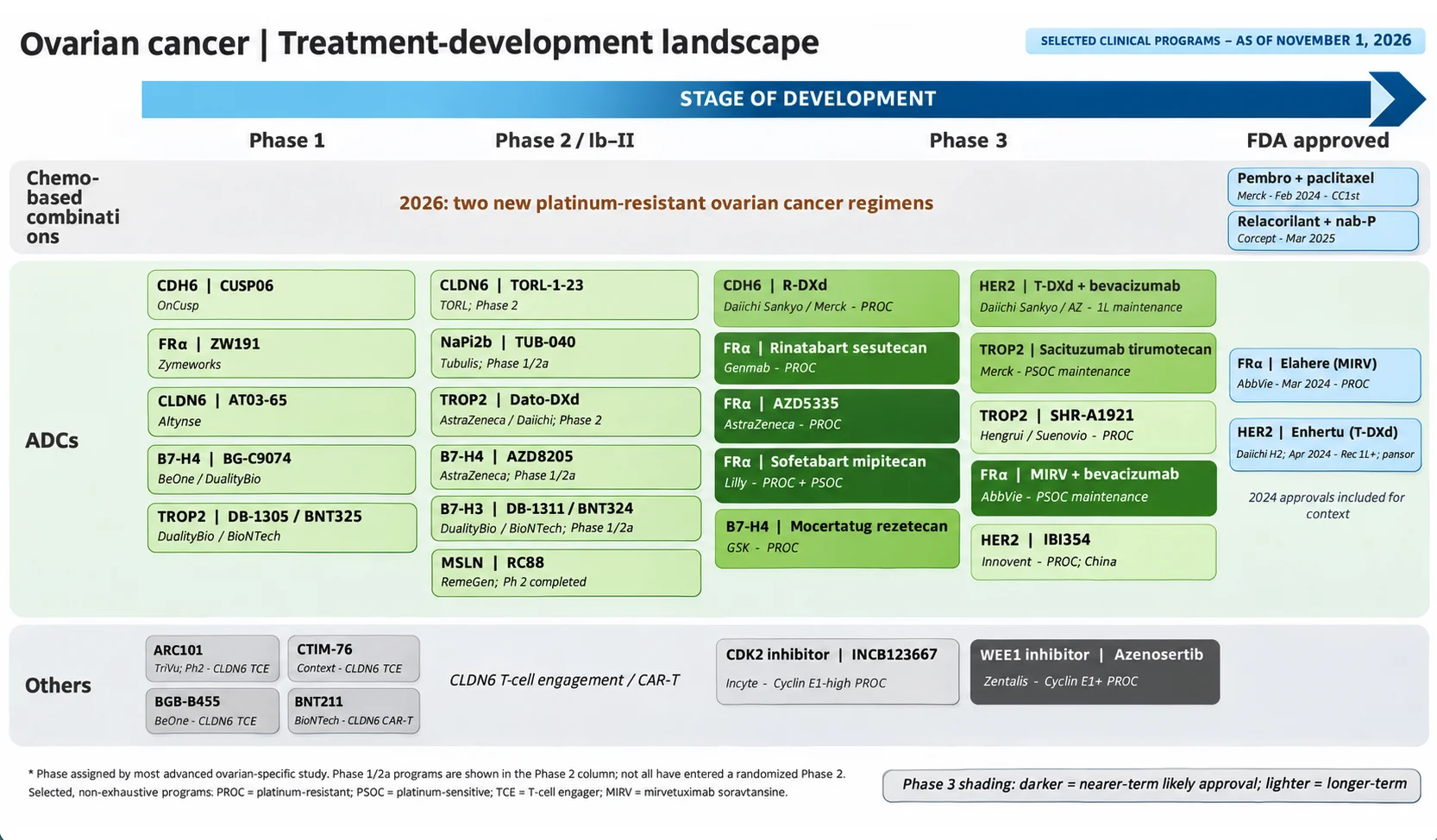
The current ovarian cancer pipeline is broader than it was only a few years ago. Researchers are testing new drug-delivery systems, mutation-specific treatments, cell therapies, immune combinations, and strategies designed for cancers that have already seen PARP inhibitors and bevacizumab.
The important distinction is that these treatments are still investigational. A high response rate in a small early study is a reason to continue studying a drug—not proof that it is better than the current standard.
More antibody-drug conjugates are entering trials
Elahere established that an antibody-drug conjugate can improve outcomes in a biomarker-selected ovarian cancer population. Many newer studies are now testing different targets and drug payloads.
One closely watched drug is TUB-040, which targets a surface protein called NaPi2b and carries a topoisomerase inhibitor payload. Early data reported confirmed responses in approximately 61% of 46 evaluable patients with heavily pretreated platinum-resistant ovarian cancer. The number is encouraging, but it comes from an early-phase, non-randomized study. TUB-040 is now being tested with carboplatin and bevacizumab in platinum-sensitive recurrence.
Another newly opened phase 1 study is testing ARR-002, an antibody-drug conjugate designed to recognize two ovarian cancer-associated targets, MUC16 and NaPi2b. The hope is that recognizing two targets will reduce the chance of missing cancer cells that have only one of them. Whether that idea translates into better outcomes is not yet known.
Mutation-specific treatments are becoming more practical
Rezatapopt is an oral drug designed for cancers with a specific TP53 Y220C mutation. It attempts to restore the activity of the damaged p53 tumor-suppressor protein.
Early ovarian cancer data have shown responses in roughly four out of ten evaluable patients. That is notable in a heavily treated population, but TP53 Y220C is present in only a small minority of ovarian cancers, and the study does not yet provide a randomized comparison with standard treatment. The phase 2 study remains active.
Other studies are attempting to exploit DNA-repair stress through targets such as WEE1 and PARG, particularly after platinum or PARP-inhibitor treatment. These approaches reflect a larger change in trial design: the goal is increasingly to match a drug to the cancer’s mechanism of resistance rather than simply adding another chemotherapy.
Low-grade serous cancer is finally being studied as a separate disease
Research in low-grade serous ovarian cancer increasingly focuses on hormone signaling, the MAPK pathway, and cell-cycle control.
In a small 15-patient study, fulvestrant plus the CDK4/6 inhibitor abemaciclib produced disease control in all evaluable patients and allowed 60% to proceed to surgery. Those results are not enough to establish a new standard, but they support larger studies of non-chemotherapy strategies in a cancer that is often relatively resistant to platinum treatment.
Immunotherapy is becoming more selective
The pembrolizumab approval does not mean checkpoint immunotherapy is now appropriate for every patient with ovarian cancer. It worked in a defined PD-L1-positive, platinum-resistant population and was given with paclitaxel, with or without bevacizumab.
At the same time, trials are testing more intensive immune approaches, including tumor-infiltrating lymphocytes, personalized cell therapies, cancer vaccines, and antibodies that connect immune cells directly to ovarian cancer cells. These treatments remain early and can involve substantial procedures, travel, and side effects.
Negative trials remain important
Not every promising treatment works when moved into a new setting.
For example, mirvetuximab is an approved and effective option for certain FRα-positive, platinum-resistant cancers. But in the MIROVA trial, combining mirvetuximab with carboplatin did not improve progression-free survival over standard platinum combinations in platinum-eligible recurrent cancer. Median progression-free survival was 9.53 months with the experimental combination and 9.79 months with standard treatment.
That does not mean mirvetuximab is ineffective. It means a drug that works in one treatment setting may not improve outcomes in another. This is why Sagely Health separates promising signals from evidence that should change care now.
Clinical trials are not a last resort
Clinical trials are often discussed only after standard treatments have stopped working. That can be too late.
Trials may test:
- A new treatment before surgery
- A way to improve the chance of cure
- A maintenance treatment intended to prevent or delay recurrence
- A biomarker-selected treatment instead of conventional chemotherapy
- A treatment for resistance to platinum, PARP inhibitors, or other drugs
- A way to reduce treatment intensity or long-term side effects
Some trials have limits on the number or type of treatments a patient may already have received. Others require a fresh biopsy, an accessible tumor, a particular biomarker, or enough time since the last therapy.
For high-risk ovarian cancer, a trial search should occur before each major treatment decision—not merely after every standard option has been exhausted. Sagely Health takes the same approach across cancer types: trials may matter in early-stage disease, higher-risk disease, and recurrence.
Questions to ask before starting ovarian cancer treatment
Bring these questions to the next appointment:
- What is my exact ovarian cancer subtype, stage, and grade?
- Has my pathology been reviewed by a gynecologic cancer pathologist?
- Was my cancer completely staged, and was any visible cancer left after surgery?
- Have I had both inherited genetic testing and tumor testing?
- Do we know my BRCA, HRD, FRα, PD-L1, and—if I have low-grade serous cancer—KRAS results?
- What is the goal of the proposed treatment: cure, preventing recurrence, producing a remission, or controlling the cancer?
- What other approved treatments could reasonably be considered now?
- Are there clinical trials for which I may be eligible before I start this treatment?
- Could starting this treatment make me ineligible for an important trial later?
- Would a gynecologic oncologist or ovarian cancer specialist at another center approach this differently?
Keep up with new ovarian cancer treatments and trials
Ovarian cancer research does not stand still
A static guide cannot cover every newly opened trial, study result, or FDA decision.
The free Ovarian Cancer Briefing from Sagely Health provides a concise, plain-language update on meaningful ovarian cancer research and newly opened trials. It is written for patients and families—not only for researchers—and focuses on what has changed and why it may matter.
Sagely Health uses the same underlying research process for its professional Oncology Intel publication and its patient-focused cancer briefings. The patient briefings translate that research without requiring readers to work through long lists or unexplained scientific language.
Know every option for your ovarian cancer
A diagnosis such as “ovarian cancer” is not specific enough to identify the best treatment or trial.
Sagely Health reviews your exact cancer type, stage, pathology, prior treatment, biomarkers, and travel preferences. We then prepare a focused report explaining the treatments, clinical trials, diagnostics, and specialists that may fit your situation.
No long lists. No unexplained jargon. Just a focused report built around your exact situation.
Frequently asked questions about ovarian cancer treatment
Is ovarian cancer curable?
Some early-stage ovarian cancers can be cured with surgery, with or without chemotherapy. The chance of lasting cure depends on stage, histology, grade, complete staging, surgical results, and other features.
Advanced ovarian cancer can respond very well to surgery and chemotherapy, sometimes for years, but the risk of recurrence is substantial. A recurrence should be treated as a high-risk decision point even when another remission is possible.
What is the standard first treatment for ovarian cancer?
For most epithelial ovarian cancers, treatment involves surgery and platinum-taxane chemotherapy.
For advanced cancer, surgery may be performed first when complete removal of visible disease appears achievable. Otherwise, chemotherapy may be given first, followed by interval surgery and additional chemotherapy.
What does platinum-resistant ovarian cancer mean?
It traditionally means the cancer progressed during platinum treatment or returned within six months of the last platinum dose.
The definition helps guide treatment, but doctors should consider the complete treatment history, previous response, remaining side effects, biomarkers, and available trials rather than relying on the six-month number alone.
Is immunotherapy now used for ovarian cancer?
Yes, but only for a defined group.
Pembrolizumab with paclitaxel, with or without bevacizumab, is FDA approved for PD-L1-positive, platinum-resistant epithelial ovarian, fallopian tube, or primary peritoneal cancer after one or two previous systemic regimens. Immunotherapy by itself is not a standard treatment for every ovarian cancer.
Which biomarker tests are most important?
All patients with epithelial ovarian cancer should be offered germline genetic testing and tumor-based testing.
Depending on the subtype and treatment setting, important results may include BRCA1/2, HRD, FRα, PD-L1, KRAS, and findings from broader tumor sequencing.
Does low-grade serous ovarian cancer mean the cancer is low risk?
No.
Low-grade serous ovarian cancer often grows more slowly than high-grade serous cancer, but it is also generally less sensitive to standard chemotherapy. Advanced or recurrent low-grade serous cancer should still be considered high risk under Sagely Health’s decision-making framework.
When should someone consider an ovarian cancer clinical trial?
Clinical trials should be considered before any major treatment decision in high-risk or recurrent ovarian cancer.
Searching early matters because some trials limit the number of prior treatments, require a particular biomarker, or require patients to enroll before receiving another therapy.
Sources and further reading
- National Cancer Institute: Ovarian Epithelial, Fallopian Tube, and Primary Peritoneal Cancer Treatment
- ASCO: Neoadjuvant Chemotherapy for Newly Diagnosed Advanced Ovarian Cancer Guideline Update
- Society of Gynecologic Oncology: Germline and Somatic Testing for Ovarian Cancer
- FDA: Pembrolizumab with paclitaxel approval
- FDA: Relacorilant with nab-paclitaxel approval
- FDA: Avutometinib and defactinib accelerated approval
- FDA: Mirvetuximab soravtansine full approval